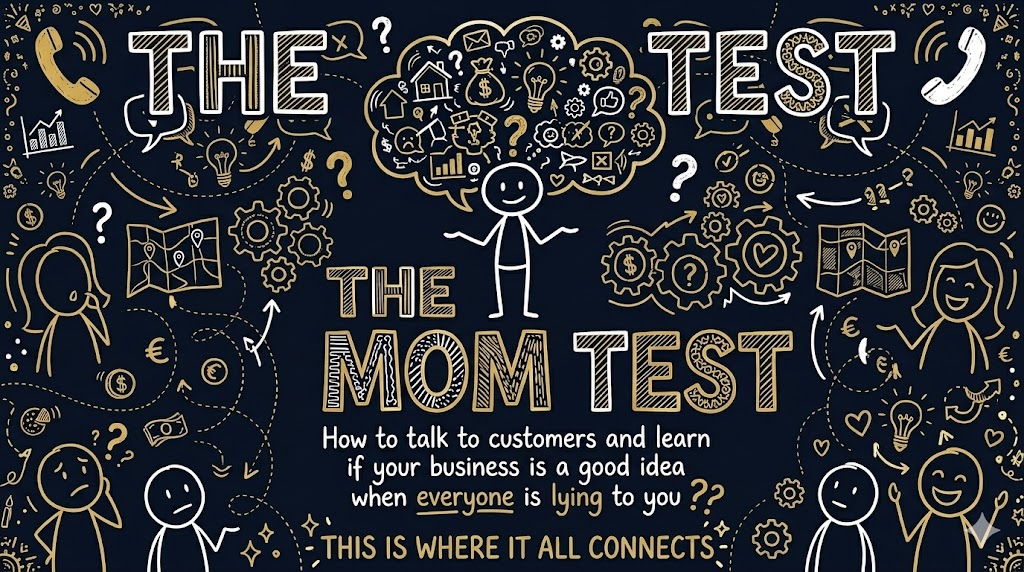
Most people don’t lie because they want to deceive you. They just avoid telling the truth because they’d rather keep things light, seem supportive, or be polite than be honest. The Mom Test, written by Rob Fitzpatrick, is a quick, practical guide on how to effectively communicate with your customers to get the best, most usable information for your business.
If you ask your mom whether your idea is good, she’ll probably say yes. Not because it’s a great idea, but because she supports you.
The problem is, this kind of feedback is useless and you will end up building the wrong things and waste a ton of resources. When you share a business idea, blatant compliments can feel good, but just like with mom, they don’t give you any real value. We see this nature of interaction not just among friends and family, but in customer conversations, stakeholder meetings, and other business interactions. By default, most conversations give us bad data. It’s our job to fix that.
Three Types of Bad Data
The book identifies 3 types of bad data: compliments, fluffs, and ideas.
1. Compliments
They make us feel good and stroke our ego, but in reality they’re either masked lies meant to be supportive or to protect your feelings. So what should you do when faced with meaningless compliments? The book tells us to bring ourselves back, regain composure, and ask the right questions. Ask about the problem they’re facing, related to the product or service you’re providing.
When someone says they like the idea, that’s not enough, because liking an idea isn’t specific. Why do they like it? What benefit would it bring to their needs? How much money would they earn or save by using it? Always remember, liking something is easy, but committing to something is not.
2. Fluffs
These include generic promises and hypotheticals, categorized into 3 sections:
- Generic Claims — “I usually,” “I always,” “I never”
- Future Tenses — “I would,” “I will”
- Hypotheticals — “I might,” “I could”
The book tells us to identify fluff responses correctly and follow the Mom Test by getting specific. Ask when it happened, how it happened, what other methods they’ve tried, and how they solved it (if they did). This is also important for separating complainers from real customers.
3. Ideas
Customers love giving ideas, but your job isn’t to say yes to all of them. Manage feature requests correctly by following the Mom Test — ask why they need this feature, what change implementing it would bring, how much money it would save or earn, and what’s missing without it.
Asking the Right Questions That Make You Uncomfortable
One of the most important aspects of any business is asking the right questions, and the Mom Test underlines this too. Going into a conversation, the author tells us we should be terrified of at least one question we’re going to ask. It might expose flaws in everything we’ve been doing so far, but it’s solid learning to help us improve. Research ahead and prepare the 3 most important things you want to learn from the meeting. If you’re not learning something new, it means you’re just going through the motions.
Don’t Pitch, and Keep Things Casual
Yes, we’ve worked hard on our ideas, our plans, our business — so obviously we want to impress others. But the moment you start pitching, people become polite, which invites compliments or fluffs — neither of which benefits us. Instead, keep things casual. Treat it like a conversation, not an interview. This applies to networking too, because humans are emotional creatures after all. Avoiding the pathos problem — trying to convince through emotion rather than reasoning — is an important part of getting the most out of your meetings.
Action Is the Key
You can plan, read, and prepare, but at some point you have to take that step — otherwise it’s the same as not researching at all. You’ll make mistakes. You’ll ask bad questions and get bad answers at first. That’s part of the journey. Learning from your own mistakes will teach you more than learning from someone else’s experiences or thoughts. Taking notes, revising, and working hard in general will invite serendipity — and in the end, that might just be the missing piece you need.
Final Thoughts
The Mom Test is a short, action-focused book that tells us not to blindly accept compliments and to ask the right questions in order to improve our business or career — something we can all relate to in our lives. While the book does move beyond its core idea of the Mom Test, the information remains very relevant throughout.
The final takeaway is this: people aren’t trying to mislead you, they’re trying to be nice. You want the truth? Ask for it. Ask for it the right way. When someone compliments your idea, don’t blindly accept it — ask why. Ask how it would benefit them. And beyond all of that, take action. Meet people in real life. And keep the Mom Test in your mind, ready to deploy.