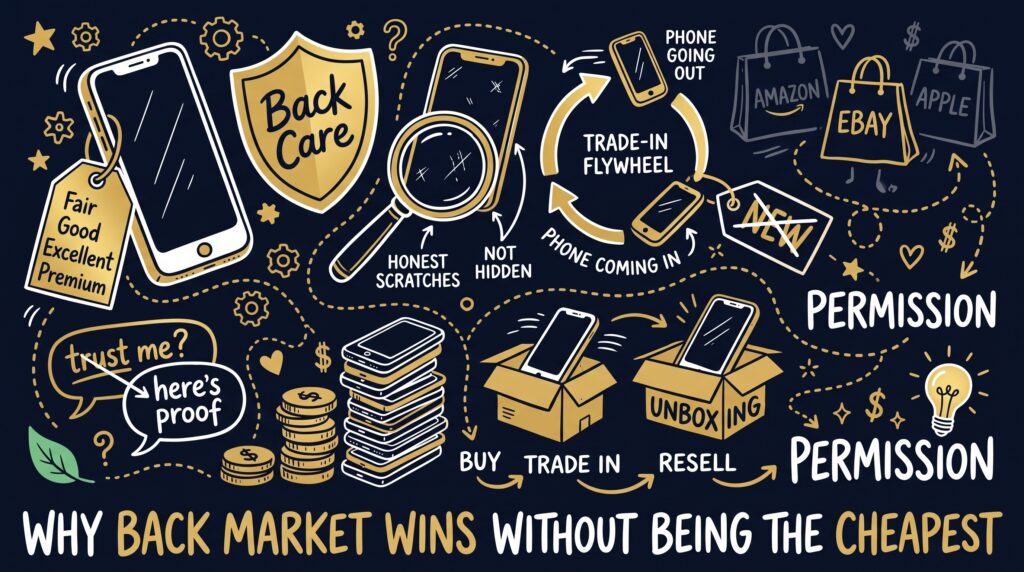
Everyone assumes the refurbished tech war comes down to price. It doesn’t. It comes down to whether you feel okay telling a friend you bought “someone else’s old phone” instead of a new one. That’s the actual product on sale here, and most of the category still hasn’t figured it out.
The field
Amazon Renewed, eBay Certified Refurbished, Apple Certified Refurbished, and Back Market are all selling functionally similar inventory: used electronics, inspected, graded, resold. Same supply. Wildly different positioning. That gap is the whole story.
Back Market vs. Amazon Renewed
Amazon Renewed wins on reach and borrowed trust: if you already trust Amazon for everything, Renewed inherits that trust for free. But it’s a buried category page, not a brand. Nobody says “I got it off Renewed.” It’s a SKU modifier, not a destination.
Back Market flips that script. The whole site is built as its own destination, not a category page bolted onto something bigger. Every part of the experience, from the copy to the grading scale (Fair, Good, Excellent, Premium, explained like a human wrote it) to the “Back Care” warranty upsell, is built to make refurbished feel like the primary decision instead of the fallback. Amazon frames it as a discount. Back Market frames it as a decision you’d defend to a friend.
Back Market vs. eBay Certified Refurbished
eBay’s problem is baggage. eBay still reads as “marketplace where things might go wrong” to a huge chunk of consumers, even though Certified Refurbished is a genuinely solid program with Allstate-backed guarantees. The certification badge is doing damage control on the platform’s own reputation.
Back Market never had to fight that battle, because it never tried to be a general marketplace. It picked one category and became synonymous with it. That’s a positioning move, not a product move. eBay could match every feature Back Market has and still lose the comparison, because the brand association isn’t there.
Back Market vs. Apple Certified Refurbished
This is the one real threat, and worth taking seriously. Apple’s program is small in catalog size but strong on trust: same warranty as new, the same box experience, made by the manufacturer itself. If you can get a refurbished iPhone straight from Apple, why go anywhere else?
Selection and the price ceiling. Apple’s refurbished inventory is thin and disappears fast, and it’s still priced close to new. Back Market’s multi-vendor model means more stock and more price points, and, just as important, it covers Samsung, gaming consoles, and laptops, everything Apple’s program will never touch. Apple wins on trust. Back Market wins on width.
The opening
Here’s the space nobody’s fully claimed: sustainability as the primary message, not the secondary one. Every competitor treats “good for the planet” as a footnote under “good for your wallet.” Gen Z and younger millennials increasingly buy refurbished as an identity statement first and a savings decision second. Whoever leads with that, and means it instead of slapping on a green leaf icon, is going to pull in the next wave of refurb buyers first.
Marketing ideas I’d pitch if I worked there
1. Make the warranty the hero, not the fine print. Back Market’s grading and warranty system is more transparent than most competitors’, but it lives on FAQ pages. Turn it into the headline creative. “We’ll tell you exactly what’s wrong with it, in writing, before you buy” is a stronger hook than any price callout, because it’s the actual objection buyers have.
2. Own “unboxing skepticism” as a content format. Instead of polished lifestyle ads, lean into UGC-style videos of people inspecting their refurbished device on arrival: scratches, battery health readouts, the works, with a tagline like “we showed you the ugly parts so you’d trust the good ones.” Radical transparency as a growth channel converts skeptics faster than any performance ad, and it’s nearly impossible for Amazon or eBay to copy without undermining their own “it’s basically new” framing.
The takeaway
Back Market didn’t win by being cheaper. It won by refusing to be a category page inside someone else’s store. When everyone else treats your category as a feature, treat it as the whole product.